

Glen and I have a rule at our Sunday-night check-in: one honest answer beats five comfortable ones. The rule came out of year 24 of our marriage, when the kids had moved out and we realized we mostly talked about logistics. The same argument about money and his long work weeks kept coming back, and we both knew the words by heart. It started as a way to talk about the budget, and somewhere along the way it became the only appointment we never cancel. We have been married 31 years, and I am old enough to know that a good marriage is mostly maintenance, not romance. So when we ordered The AND Long Term Couples Edition, 199 conversation cards for couples, I told him we would use the deck for six weeks before either of us said a word about whether we liked it. He raised an eyebrow, the same eyebrow he raises when I suggest a fun spreadsheet, and dealt the first card. What I did not expect, sitting at our kitchen table in Bend with the coffee going cold, is that a card the size of my palm would do what our best arguments had not done in months. It asked us something we had never thought to ask each other.
Foundations Cards came into the picture because a friend from my old library days loaned us her deck. She described it as a course in a box, and that is exactly what it feels like. Where The AND hands you one question and trusts you to go where it leads, Foundations organizes its questions into guided chapters that build on one another. We ran both decks for the same six weeks, alternating Sunday evenings, and we kept notes in a spiral notebook that still lives in the kitchen drawer. I dated every entry, because I wanted to see whether a deck could change what we talked about on an ordinary Tuesday, not just a planned date night. I also wrote down what we actually said, not just what we were supposed to talk about, because the real conversation is always in the detours. This is the honest version of what we found: the deck you should buy depends on whether your marriage needs a warm-up act or a structured rehearsal. Most couples, and I count us among them, need both at different times. One of these decks made it into our regular rotation, and the other went back to my friend with thanks. I have been thinking about Foundations ever since.
| The AND Long Term Couples Edition | Foundations Cards | |
|---|---|---|
| Cards included | 199 cards, drawn at random, enough for months of nightly use without a repeat | Around 100 cards, organized into themed chapters that you work through in order |
| Time per session | 5 to 10 minutes for one card and one honest answer from each of you | 20 to 40 minutes for a full chapter, plus time to write things down |
| Structure | Shuffle and draw, no prescribed order, you steer how deep to go | Chapters that build on each other, designed to be done week by week |
| Depth of prompts | Short, open questions that get one honest sentence, with room for a follow-up | Multi-part questions with space to write, reflect, and come back to |
| Best for | A weekly check-in that keeps a long marriage warm | A planned date-night deep dive when you both have real energy |
| Replay value | 199 prompts, so a nightly draw goes months without repeating; the same card lands differently a year later | Fewer prompts, but chapters reward a second pass to see how your answers changed |
| Hard topics | Money, in-laws, and the same old fight come up naturally, but you decide the depth | Guided steps walk you through one hard topic at a time, in order |
Where The AND Wins
The first thing The AND did right was show up on a Tuesday night, not a Sunday. Glen had come home from a three-week survey job near Prineville, the kind of stretch that turns a marriage into a logistics meeting. He works twelve-hour days in the field, and when he is home he is usually tired, and I have learned that tired men still talk if you hand them a question instead of a lecture. I made the same mistake I always make, which is to wait for him to bring up what is actually wrong. Instead I dealt a card that asked what we wished we still did together that we used to do, and I slid it across the table. He read it twice. Then he said he missed when I used to come stand in the garage and talk to him while he worked on the truck. That is not a sentence that comes out of a marriage that has gone quiet. It came out because the card gave him the first line. The AND is built for those moments. The prompt does the heavy lifting so neither of you has to find the courage to start. We sat there for another hour, and the coffee went completely cold. I did not care. That night I wrote in the notebook: he misses the garage. It sounds small. It is not small. That was the first Tuesday in months that ended with us talking, not scheduling.
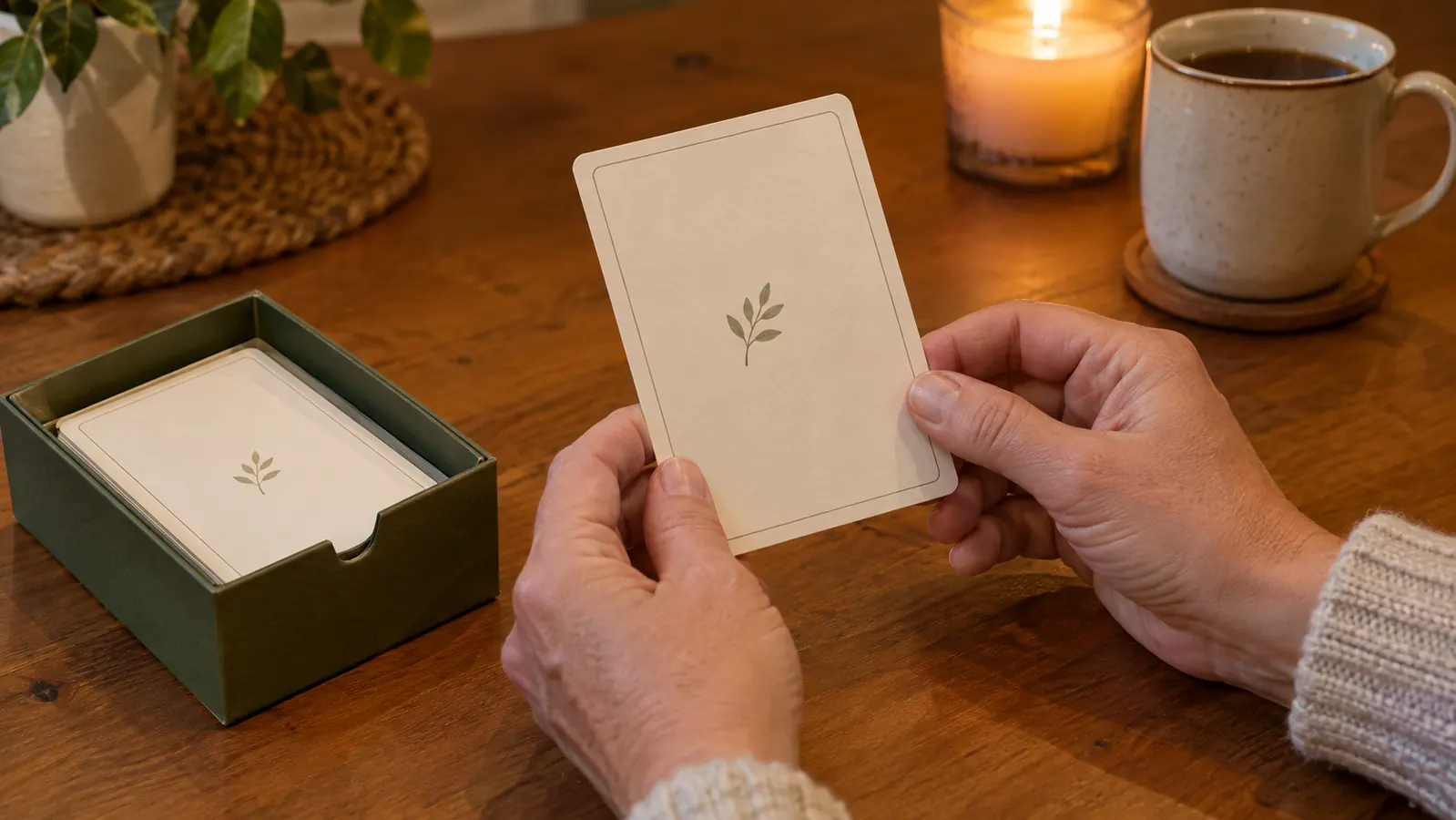
The other thing I love is that it asks for five minutes, not an evening. Some nights Glen and I are too tired for a full conversation, and a card from The AND still works because one honest answer is enough. We kept the deck on the kitchen counter, not in a drawer, which is where every other deck we have owned has gone to die. The box is worn now, and the cards have soft corners, and that is exactly what I want a tool for our marriage to look like after two months. 199 cards meant we went ten weeks without repeating a single prompt, and when a card did come around again, our answers had changed enough to make it interesting. One card asked what we were each proudest of in the other, and Glen, who is not a man of big speeches, talked for six minutes about the year I went back to finish my library degree while working nights. Another asked what I would do with a free Saturday, and I said sleep, and he laughed, and that was the whole conversation, and it was enough. Some cards are heavy and some are light, and the deck does not care which one you need. That matters more than I can say. The deck has no agenda. You shuffle, you draw, you answer, and there is no chapter you are supposed to finish and no progress to fall behind on. The deck does not grade you. There is no score at the end of the week, and I have come to believe that is why it works. For a couple that has spent 31 years building a life together, that lack of homework is the whole point. We do not need a curriculum to know we love each other. We need a first line.
Where Foundations Wins
Foundations Cards won the weeks when we needed more than a warm-up. The deck is built like a curriculum. The cards are organized into chapters, and each chapter walks you through one territory: the story you tell about your childhood, the way you fight, the things you assume about each other without saying them. You are meant to go through a chapter in one sitting, and a sitting takes real time. The night we did the chapter on money, we were at the table for forty minutes, and I wrote down more in the notebook than I had in a month of Sundays. Glen told me something about the year his father lost his job that I had never heard in three decades of marriage. He was twelve. He remembered his mother crying in the kitchen and his father not talking for a month, and he had never once connected that memory to how hard Glen works now. I wrote the words his father was ashamed, and Glen nodded, and we sat with it. I had to stop writing once because my hand was shaking. Not from anger. From the size of what he had just told me. The instructions say to write before you speak, and I have always hated writing before speaking, which is probably why I needed it. A single card from The AND might have gotten us there eventually. Foundations made it almost impossible to avoid.
Foundations is also the better deck when you both know the topic and neither of you knows how to start. The guided steps do what a spouse cannot always do, which is to keep the conversation from veering off into the same old fight. There were moments when I could feel Glen bracing, and the card kept us on the path. But that structure has a cost. It is harder to pick up on a tired Tuesday, and we found ourselves scheduling Foundations sessions the way we schedule a doctor's appointment, which is useful and also, honestly, a little grim. We had to be in the right mood, with real time and real energy, or the chapter sat half finished and made us both feel behind. Glen said it best one night: this deck makes you do your homework, and some weeks we already had homework. We finished the chapter on money with a list of three things we each wanted to change, and we have actually kept two of them. And yet the next week we opened the next chapter anyway, because we had started something and neither of us wanted to be the one who quit. The chapters we finished gave us more than the chapters we skipped, and the skipped ones were always our fault, not the deck's. I respect Foundations more than I enjoy it. It is a deck for a couple that is ready to do the work, not a deck that makes the work feel light. That is not a criticism. It is a description of a different job.
The deck that fits a tired Tuesday
The AND Long Term Couples Edition is the one that stayed on our kitchen counter. 199 cards, five minutes at a time, no homework, no chapters to fall behind on. If your marriage needs a warm conversation more than a curriculum, this is the deck that made us talk again.
Amazon Check Today's Price on Amazon →
Who Should Buy Which
Buy The AND if you and your spouse are like us, which is to say mostly fine and a little too quiet. It is the deck for the Sunday-night check-in that keeps a long marriage warm. It fits the nights when you are tired, it never makes you feel behind, and 199 cards means you will not run out of first lines. It is also the safer choice for a couple that has never used a question deck, because there is no wrong way to use it. You draw, you answer, you put it back, and nobody has failed at anything. That is a feature, not a softness. Thirty-one years in, I have learned that the marriages that last are not the ones with the most dramatic conversations. They are the ones where small honest conversations still happen on a regular Tuesday, with the coffee going cold and the cards spread across the table. If that sounds like the marriage you want to keep, The AND is the deck that fits it. We are not a couple in trouble. We are a couple that got quiet, and quiet is its own kind of trouble. It is not a tool for a marriage in crisis. For that, please find a licensed counselor, because we are not those people and a card deck is not that.
Buy Foundations Cards if you have a specific conversation you have been avoiding for years, or if one of you keeps saying we should talk about this sometime and the other keeps agreeing and nothing happens. The structure is exactly what a stuck conversation needs. And if you can manage both, that is what I would do: Foundations for the hard Tuesdays, The AND for every other night of the week. If you only buy one, buy the one that matches the season your marriage is in. We needed The AND first, to remember that we still liked talking to each other. The Foundations deck went back to my friend, but I have thought about ordering our own copy. Maybe next year. Maybe when we are ready for the work, and not just the warm-up. A question deck is a small thing, but a conversation is not, and that is the only honest way I know to compare them. That is the real test of a deck: not whether it is clever, but whether you reach for it again on a Tuesday. And if you are buying a gift for a couple you love, buy the deck you would want to use with them, not the one that looks most impressive on the coffee table.
Start with the deck that keeps showing up
After six weeks of both decks, The AND Long Term Couples Edition is the one still sitting on our kitchen counter. It asks for five minutes, it asks an honest question, and it lets you steer. That is a good description of a marriage worth keeping warm.
Amazon Check Today's Price on Amazon →