
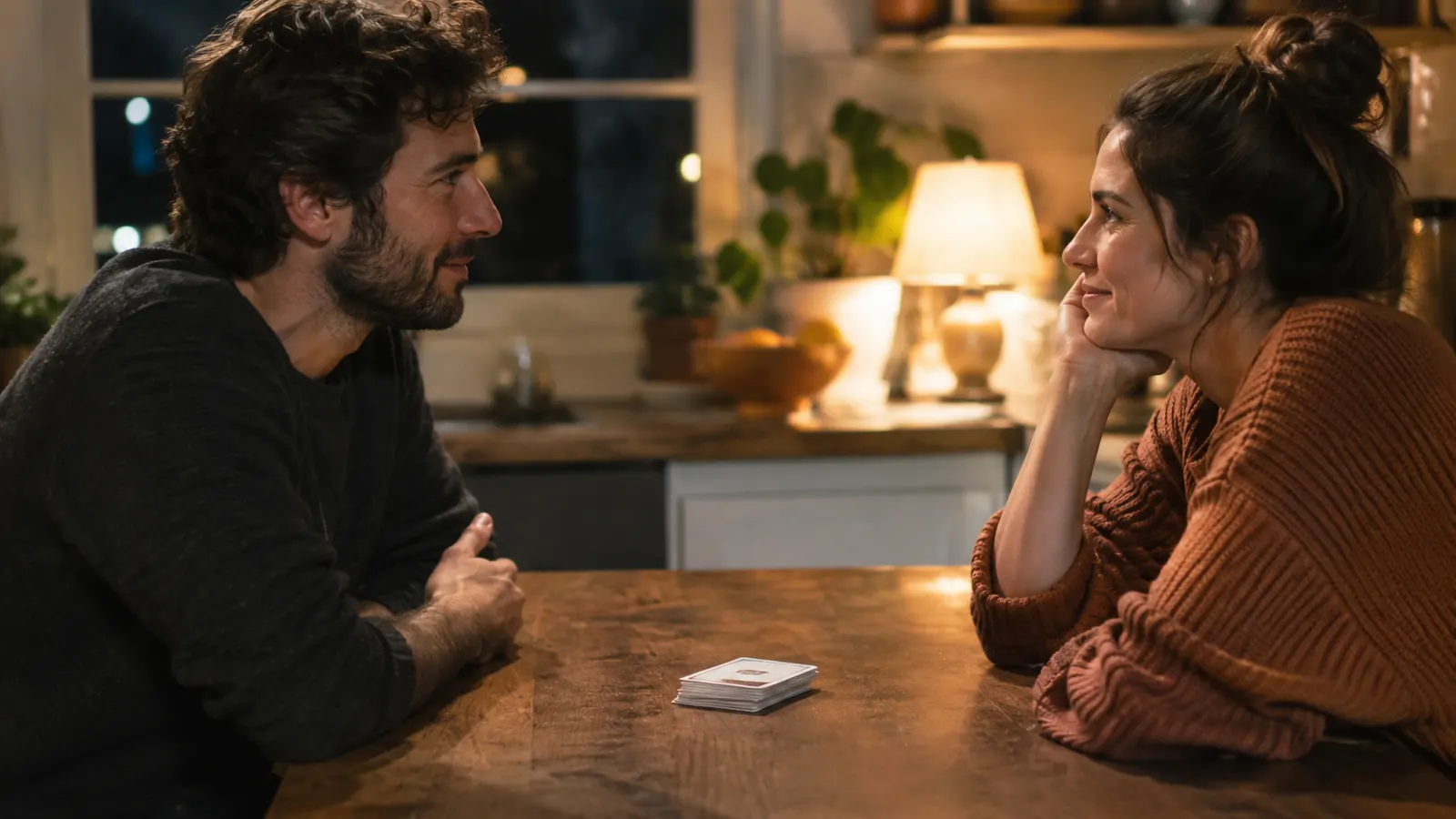
Glen and I have been married 31 years, and for most of them our date nights looked the same: a reservation, two glasses of wine, and a conversation that circled back to the kids, the budget, and his work week. We were together, but we weren't really hearing each other. Around year 24, with the kids out of the house, we realized we mostly talked logistics, and the same argument about money and his long work weeks kept coming back. We started a weekly Sunday-evening check-in at the kitchen table, and somewhere in there we left the restaurant out of it. One night Glen set a deck of cards between us instead of a menu, and the questions did what two people staring at each other across a table never quite managed. We're Not Really Strangers Couples Edition turned our kitchen table into the best date spot in Bend, and I've got ten reasons why a question game beats another dinner out.
Skip the reservation. Sit down with the deck that starts the real conversation.
We're Not Really Strangers Couples Edition is the card game that got Glen and me talking past logistics again. It takes ten minutes to set up and zero planning.
Amazon Check Today's Price on Amazon →You actually face each other, not the TV
At a restaurant you're angled toward the room, the server, the door. At home, with a deck between you, the only thing to look at is each other. The first time we played, a Tuesday in February, I noticed Glen's face the way I did when we were dating. He had spent the day running a boundary survey up near Tumalo and came home late, and I expected the usual tired silence. Instead, between two cards, he laughed at something I said and I saw the same expression from our first apartment. There's no background music, no one refilling water, no dessert menu arriving at the wrong moment. It's just the two of you and the next card. That alone made it worth it.

The questions do the awkward first step
The hardest part of a deep conversation is starting it. The cards hand you the opening line. Some of the questions are light, some are heavy, but you never sit there wondering what to say next. The deck carries the awkward part so you don't have to. One card asked us to finish a sentence about what we were afraid to say out loud, and Glen answered it before he could talk himself out of it. A restaurant table never gives you that nudge.
It costs a fraction of a dinner out
One restaurant bill covers the deck several times over, and you can use it every week for years. No tip, no gas, no forty-minute wait for a table. We used to budget date night into the month; now it lives in the drawer next to the takeout menus. We have played it on anniversaries, on ordinary Tuesdays, and on a night when the dishwasher broke and we needed a reason to stay in the kitchen. Just you, your person, and a stack of cards that never runs out of material.
You hear answers you've never heard before
After three decades I thought I knew every Glen story. The deck proved me wrong. One card asked about a moment he'd relive if he could, and he told me something from his twenties I'd never heard. He said he would go back to a summer evening in 1987 when he and two friends camped at Waldo Lake and watched a storm roll across the water. I knew about the camping trip, but not that he thought of it as the most peaceful he had ever been. He told it slowly, and I sat there not wanting to interrupt. When he finished, he looked almost surprised that he'd said it. We sat with the quiet for a minute, and then he picked the next card. You can't order that from a menu.
It slows the night down
A dinner out has a rhythm: order, eat, pay, leave. A card game has no clock. One Sunday in March we sat down at seven and played six cards; when I looked up it was 9:15 and the tea had gone cold. At a restaurant, the check arrives and the spell breaks. Here, the only thing telling us to stop was our own yawning. We've learned to start earlier on nights when we both have work the next day. The game gives you permission to be unhurried, and that's the thing modern date nights are missing.

It works even when you're both tired
Some weeks we are exhausted by Friday. The last thing I want is to put on real pants and make small talk with a server. Pulling out the deck on the couch in sweatpants still counts as a date. Low effort, high connection. We have played in pajamas, with tea, and once when Glen was half-asleep, and the cards still did their work. A restaurant would have felt like an obligation that night; the couch felt like a gift.
It surfaces the small stuff before it becomes big stuff
The best questions aren't the dramatic ones. They're the ones that reveal a small annoyance or a quiet hope. Last spring a card about weekends made Glen say he felt like we never did anything on his terms. It wasn't a fight, just a sentence he needed to say. It wasn't a dramatic confession. It was just true. We caught a recurring frustration about weekend plans before it turned into the same old argument, just because a card asked the right question. A month later we were taking turns choosing Saturday mornings, and neither of us had to bring it up again.
You remember the night, not just the meal
Ask me what I ate at our anniversary dinner last year and I'll draw a blank. Ask me what Glen said when a card asked about the bravest thing he's done, and I can tell you word for word. It was about a job he took in his thirties that scared him, and the way he described walking onto that site still stays with me. I remember the light in the room, the way he held the card, the pause before he answered. The game makes memories that stick.
It's a ritual you can actually keep
Restaurant date nights get cancelled when life gets loud. A deck in the drawer doesn't. We play most Sunday evenings now, and it's become the anchor of our week. When Glen comes home late from a job, we move it to Monday. The point isn't the night of the week; it's that we keep the date. Even on the weeks when we only get through four cards, we have still sat down and looked at each other. A ritual you can keep beats a reservation you have to reschedule.
It reminds you why you chose each other
The deepest questions circle back to the same place: why this person, why this life. We're Not Really Strangers asks those questions on purpose. By the end of a round, I remember exactly why I married Glen. Not the big reasons only, the small ones too, the way he laughs at his own jokes, the way he checks the locks before bed, the way he still holds my hand at a red light. That feeling is the whole point of a date.
What I'd Skip
I'd skip this deck if you're looking for a party game or something to play with a group. It's built for two people who want to go deep, and it can get quiet and serious in the best way. I'd also skip it on a first date with someone you barely know; save it for a relationship with some history. And if you're in a place where a conversation feels unsafe, no card game is the answer. For abuse, safety, or serious mental health concerns, please talk to a licensed professional. This is a tool for connection, not a repair kit. It won't fix what needs a counselor, but it can open a door that had gone quiet. And give it more than one night. The first round can feel awkward, like any new conversation. By the third Sunday, it stops being a game and starts being a habit.
One card asked about a moment he'd relive if he could, and he told me something from his twenties I'd never heard. You can't order that from a menu.
Your kitchen table is already the best table in town.
We're Not Really Strangers Couples Edition turns an ordinary evening into the conversation you've been meaning to have. No reservation required.
Amazon Check Today's Price on Amazon →