
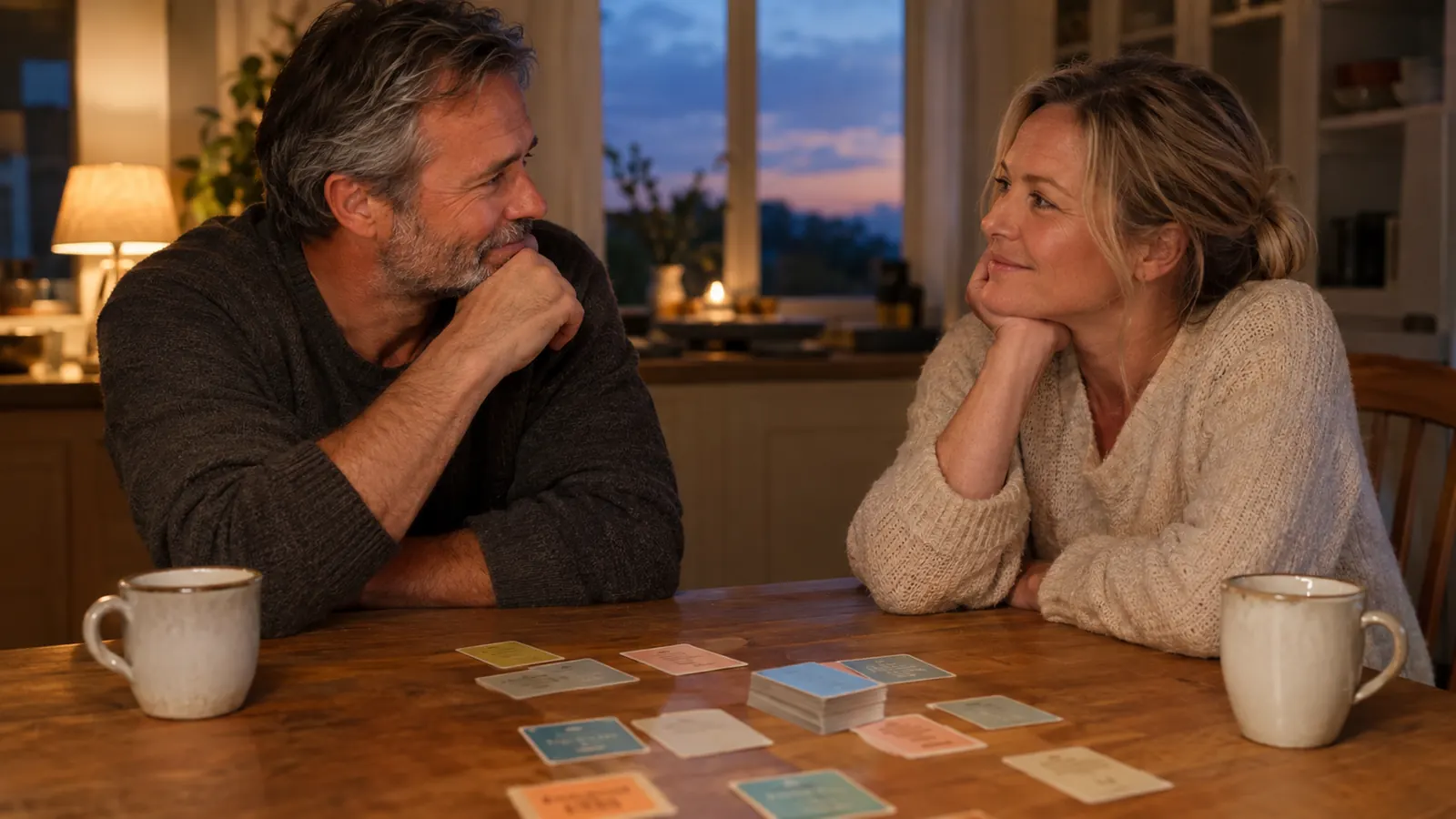
Glen and I have played a lot of question decks over the years. Some of them get one honest conversation out of us and then sit in a drawer. Others have become part of our Sunday-evening check-in, and We're Not Really Strangers Couples Edition is one of the few that stayed on the kitchen counter. The question was whether Better Together could do the same job, so we played both on back-to-back Friday nights, the last Friday of January and the first Friday of February, with the same rule: no phones, no TV, no dodging the hard ones. I put my phone on the charger in the bedroom, face down, and made the tea before we sat down. We gave each deck one full evening, no rushing. I kept a note on the back of an old receipt about what each game actually made us talk about, and that note turned out to matter more than any scorecard I almost made. The first Friday, with Better Together, the note has three entries, and two of them are about lunch. The second Friday, with We're Not Really Strangers, the back of the receipt was full. I am a retired middle-school librarian, so of course I kept notes. Old habits die hard, and the notes turned out to be the most useful part of the experiment.
The short answer is that they are not really competing for the same job. We're Not Really Strangers Couples Edition asks deeper questions faster and gives you a structure that keeps a real conversation going, even when one of you would rather change the subject. Better Together is gentler, more playful, and easier for a couple who has not done this before and is a little nervous about what might come up. For us, deep does not mean dramatic. It means a question that makes Glen put his mug down and think before he answers, and there are more of those in one level two session of We're Not Really Strangers than in a whole evening of Better Together. The gap showed up fast. After one evening with each deck, I knew which one would still be on the counter in June. If you want to go deep on a quiet night in, choose We're Not Really Strangers Couples Edition. If you want a light, low-pressure warm-up, Better Together is the kinder starting point. We kept one deck on the counter and passed the other along to one of our kids. I will tell you which at the end. If you only read one section of this, read the last one. It is the part I wish someone had told me before we bought either deck.
| We're Not Really Strangers Couples Edition | Better Together | |
|---|---|---|
| Question depth | Three levels that move from easy to genuinely uncomfortable, with a final level that asks about desire, trust and apology | Playful prompts about memories, quirks and hypotheticals. Sweet, but rarely goes below the surface |
| Pacing | Structured rounds with a clear arc. You can spend an hour on level two alone | Draw and answer at your own pace. Stops and starts whenever you want |
| Ease of starting | Level one is friendly, but the deck expects you to keep going deeper | The lightest prompts make it the easiest first card game for a nervous couple |
| Replay value | Levels, wildcards and a progression that lands differently each time you answer honestly | A single deck of prompts that most couples exhaust in two or three sittings |
| Time for one full play | About an hour and a half if you let it, and the conversation usually keeps going | Twenty minutes is enough for a full round when you are tired |
| Party potential | An intimate two-person experience. The questions feel too personal for a group | Light enough that a group of friends can pass the deck around without anyone feeling exposed |
| Best for | Long-term couples who want to hear each other again | Newer couples or anyone who wants a fun night without heavy feelings |
Where We're Not Really Strangers Wins
We're Not Really Strangers Couples Edition is built like a small journey. The deck is divided into three levels, and each level asks you to go a little further than you planned. Level one is friendly enough for a first date. We got through it in about twenty minutes and laughed the whole way. A couple of the level one questions are the kind you would ask on a first date, which is fine, because they warm up your voice before the real questions show up. Level two starts asking about your childhood, your fears, and the things you assume about each other. One question in that level led Glen to tell me about his father's old truck, the one he learned to drive in, and I realized I had never heard that story in thirty-one years of marriage. Level three is the one that made us both put our mugs down. It asks about the things you have not said, the apologies you owe, and what you need from each other right now. That last level is where the deck earns its keep.
The structure matters as much as the questions. Because the levels build, you never start with the hardest question. By the time you reach level three, you have already been talking for half an hour, so the hard questions feel like a continuation instead of an ambush. We're Not Really Strangers also includes wildcards and a few cards that tell you to put the deck down and just talk for a while. That built-in permission to stop reading cards and actually speak is something Better Together never gives you. We used it twice. The first time, we talked for twenty minutes about the summer our kids left home and neither of us said how quiet the house felt. I did not realize I was still carrying that until I heard myself say it out loud. The second time, Glen asked me a question of his own, the kind he usually waits for me to raise. The deck handed him an opening and he took it. We did not plan any of that. The deck just made room for it. That is the kind of thing no scorecard can capture, and it is the reason I keep coming back to this deck instead of the other one.
We're Not Really Strangers also wins on replay value. Better Together is a deck of fun questions you can exhaust in two or three sittings. The Couples Edition has levels, wildcards, and a progression that feels different each time, especially when you answer honestly instead of reaching for the easy reply. We have played it four times since January, and in our most recent game, a level two card about what I assume about Glen's workday stopped him mid-sentence. He sat there for a long moment, then told me that most days he is not sure the younger surveyors need him out there the way they used to, and that he has been thinking about what comes next when the long field days are behind him. That moment, the one where your partner goes quiet and you wait, is the whole point of the game. I have never had a party game do that. I am not sure a party game is supposed to.
Where Better Together Wins
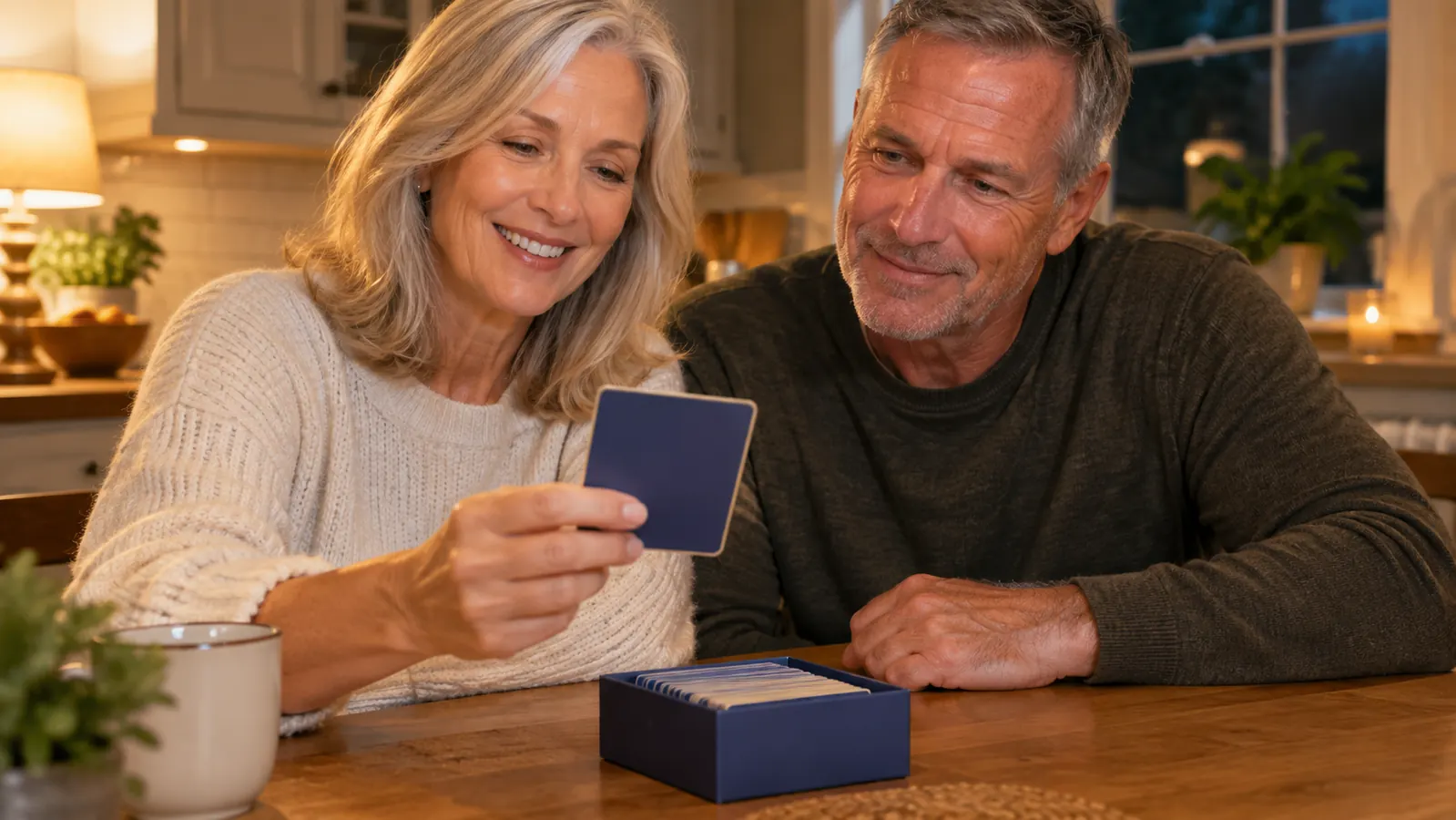
Better Together is the easier yes. The prompts are playful, positive, and almost impossible to get wrong. Where We're Not Really Strangers pushes you toward the uncomfortable, Better Together asks about favorite road trips, the song you would want at your funeral, and the small things you notice about each other. For a couple that has never played a question game, or one that is still a little fragile, that gentleness is a real advantage. The Friday we played it, Glen came home from a week of field work and was asleep on the couch by eight. We still played, but we played slow, and the deck did not mind. Better Together does not demand anything of you. The cards are short, the questions are warm, and the whole thing can be done in twenty minutes if you want it to be. There is a real place for that, and it is not a small one. It is the deck you reach for on a Tuesday, not the deck you save for a Saturday when you both have the energy to go somewhere hard.
It also works better as a party game. We're Not Really Strangers is an intimate, two-person experience. Better Together can be played by two people, but the prompts are light enough that a group of friends can pass the deck around without anyone feeling exposed. If your goal is a fun night with another couple, Better Together is the better fit. If your goal is to actually hear your husband again after a season of logistics-only conversations, it will probably leave you wanting more. That is exactly what happened to us. We finished Better Together in one sitting, laughed, said good night, and then lay in the dark for ten minutes before Glen said, "That was fun. It did not feel like us, though." The next week we started We're Not Really Strangers and did not stop talking until the tea went cold. The difference was not that one deck is good and the other is bad. The difference was that one of them asked us to stay. I have thought about that sentence a lot since February. It is the truest thing I can tell you about either game.
I want to be fair about what Better Together does that the other deck does not. It never leaves anyone stranded. Every question in Better Together has an easy landing, so a quiet partner can answer in two sentences and still feel included. We're Not Really Strangers sometimes asks a question that requires a real answer, and if you are tired or stressed, that can feel like homework. There were two or three nights this winter, after a long week and a later dinner than we planned, when I did not want homework. On those nights, a gentle deck is a kindness, not a compromise. Better Together understood the assignment. It is not a lesser version of the other game. It is a different tool for a different evening, and we are big enough to admit we need both kinds.
The deck that made Glen go quiet
If you want a date night that actually goes somewhere, We're Not Really Strangers Couples Edition is the one we keep reaching for. Check today's price on Amazon and see if it earns a spot on your kitchen counter.
Amazon Check Today's Price on Amazon →
Who Should Buy Which
Buy We're Not Really Strangers Couples Edition if you have been married for a while, if you already talk about the kids and the bills and the schedule, and if you are ready to talk about something real. It is also the right choice if you have played lighter question games and found yourself bored. The deck meets you where you are and then asks you to go further. Glen and I are not therapists, and this game is not therapy. It is a tool that helps two people sit down and actually listen to each other. We started our Sunday-evening check-in around year twenty-four, when the kids were gone and we realized we mostly talked about logistics. The same argument about money and his long work weeks kept coming back. A deck cannot fix that by itself. But a deck that asks the right question at the right moment can open the door. That is what happened on our second Sunday with We're Not Really Strangers, when a level two card about what we each think the other one is afraid of turned into the first real conversation we had had about his retirement timeline. It did not solve anything that night. It just made the thing sayable. We did not finish the conversation that night. We picked it up again on the next Sunday, and the Sunday after that.
Buy Better Together if you are a newer couple, if you want a low-pressure date night, or if the idea of a question about your deepest fear sounds exhausting rather than exciting. It is a lovely, warm deck, and it has its place. For us, it was the appetizer. We're Not Really Strangers Couples Edition was the main course, and it is the one still sitting on our kitchen counter next to the tea canister. Better Together went to one of our kids, who is at the stage where a light question about favorite road trips is exactly the right amount of conversation for a Tuesday night. That is not a knock on the game. It is knowing your audience, and the audience matters as much as the deck. A deck is not a test you pass. It is a door you walk through together, and you get to choose which door is right for the season you are in.
If you are still deciding, start with the easier of the two if that is what gets you to sit down at all. The best deck is the one that actually gets played. We kept the harder one, but we have both on the shelf now, and that is the honest answer. But if you are anything like us, married long enough that the conversations have gone quiet, do not let the light option be the only option. Ask for the hard questions on a night when you have the energy for them. We're Not Really Strangers gives you a safe way to do that, and in our house it earned the spot on the counter. If you buy one deck this year, make it the one that scares you a little. Those are the conversations you will remember in June.
Make your next quiet night in count
We're Not Really Strangers Couples Edition is the deck that turned our Friday nights into conversations we actually remember. See today's price on Amazon and start with level one.
Amazon Check Today's Price on Amazon →