
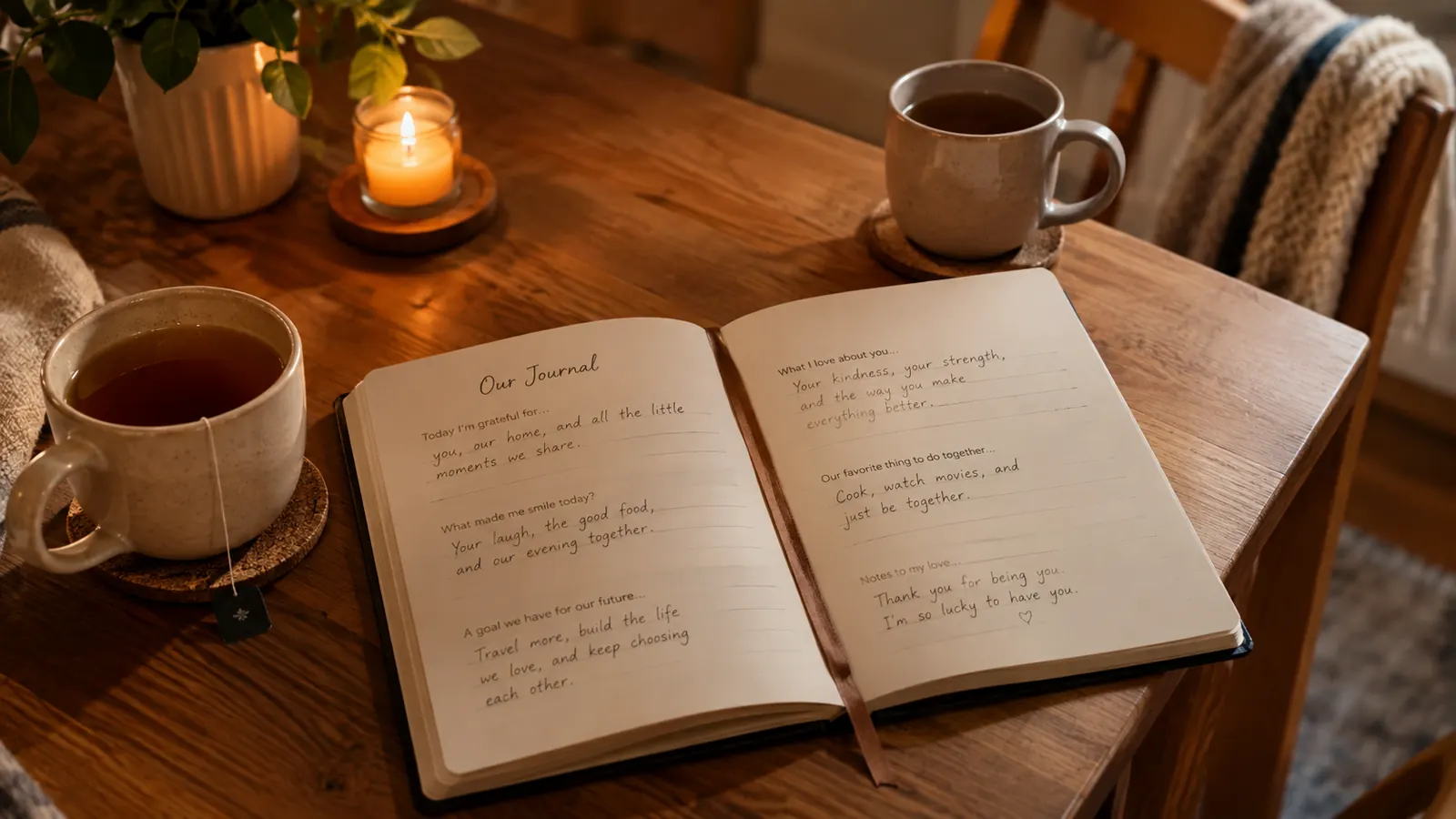
Glen and I have been married 31 years, and somewhere around year 24 we looked at each other across the kitchen table and realized we only talked about logistics. Who was picking up the dry cleaning. When the gutters needed cleaning. Whether we could afford the roof repair. The same argument about money and his long work weeks kept coming back, and the kids were gone, so there was no buffer anymore. That is when we started our Sunday-evening check-in, and it is also why I keep trying tools like A Year of Us by Alicia Muñoz. I wanted to know whether a daily question journal could do what our weekly check-in did, or whether it would just become another thing on the counter we ignored by February.
I used A Year of Us every day for a full year, mostly at breakfast, sometimes at the kitchen table after dinner when one of us was too tired to talk. I am not a therapist and I do not play one in this review. I am a retired middle-school librarian who has read a lot of marriage books and tried a lot of tools with Glen, and I can tell you exactly which prompts made us talk and which ones we skipped. That is what this review is for.
The Quick Verdict
A Year of Us is the rare couples journal that assumes you already love each other and just need a reason to talk. It will not fix a marriage in crisis, but for a solid marriage that has gone quiet, it is the best daily prompt book we have tried.
Amazon Check Today's Price →A daily question that takes two minutes and starts a real conversation
Glen and I spent a year with A Year of Us and it became the part of our morning we actually looked forward to. If your marriage has gone quiet, this is the gentle nudge that gets you talking again.
Amazon Check Today's Price on Amazon →How I Used It
The premise is simple. One question a day, a line to write your answer, a line for your partner's answer, and a little space to compare. The questions are grouped by month with themes like connection, play, and gratitude, and there is no pressure to write a lot. Some days we wrote one sentence each. Some days we wrote a paragraph. Some days we just read the question out loud and talked about it without writing anything, which I think counts as using it.
We kept the journal on the kitchen counter next to the coffee maker, so it was impossible to miss. I answered first while the coffee brewed, Glen answered when he came down, and we read each other's answers out loud. That ritual mattered more than the questions themselves. The journal gave us a reason to sit down together for ten minutes, and the questions gave us somewhere to start.
I will be honest about one thing. We did not do every single day. We missed a week in March when Glen was on a big survey job, and we missed a few days here and there when life got loud. The book does not punish you for that. You just pick up on the next day's question and keep going. That flexibility is part of why we actually finished the year.
The part that mattered most turned out to be reading our answers out loud. For the first few weeks we each wrote our line and moved on, which was pleasant and did almost nothing. Then one morning Glen read his answer to me before I had seen it, and it was not what I expected at all. I asked a follow-up question, he answered, and we were both late leaving the house. After that, reading out loud became the rule. The writing is the warm-up. The conversation that happens after you hear your partner's answer in their own voice is the actual point of the book.

What Nobody Tells You About Daily Couples Journals
The first thing nobody tells you is that the questions are not the hard part. The hard part is showing up two days in a row, then three, then a week. A Year of Us makes that easier because the questions are genuinely light. They are not the heavy, tearful prompts you see in therapy workbooks. They are things like 'What made you laugh today?' and 'What is something you are looking forward to?' That sounds almost too simple, but simple is what makes it sustainable.
The second thing nobody tells you is that some questions will fall flat, and that is fine. There were prompts about dream vacations that made us both shrug because we are homebodies. There was a question about our first date that we have answered so many times it felt like a rerun. We skipped maybe a dozen questions all year. The book does not break if you skip one, and neither does your marriage.
The third thing is the one I want you to hear. A daily journal will not fix a marriage that is in real trouble. If you are in couples counseling, if you are wondering whether to stay, if there is abuse or safety concerns, a question journal is not the tool for you. Please talk to a licensed professional instead. What A Year of Us is good at is keeping a good marriage connected, and that is a different job entirely.
The question that got us talking again was not about our marriage at all. It was about what we each wanted for the next ten years, and we had never actually asked each other that.
The Prompts That Landed
The best questions were the ones that sounded ordinary and then surprised us. One morning the prompt was something like 'What is a small thing your partner did this week that you noticed?' Glen wrote about the way I leave his coffee cup on the counter exactly where he will see it. I wrote about how he texts me when he is driving home so I know when to start dinner. We have been married 31 years and we still needed a prompt to say those things out loud.
Another prompt that landed was about what we each wanted for the next ten years. Glen is 58 and I am 56, and we had never actually asked each other that. He wants to fish more and work less. I want to volunteer at the library and maybe take a watercolor class. Neither of us knew the other's answer, and we have been sharing a house for three decades. That is the real value of this journal. It creates space for the questions you assume you already know the answer to.
The monthly themes helped too. January was about connection, and the questions were all variations on 'how are we doing?' By the time we got to the gratitude month, we were in the habit of actually answering instead of just going through the motions. The structure gave us a gentle arc across the year, and I did not realize I needed that until we were three months in.
The Prompts That Fell Flat
I said I would be honest, so here is the honest part. Some of the questions felt like they were written for a couple in their twenties who just moved in together. There were prompts about spontaneous road trips and dancing in the kitchen, and Glen and I looked at each other and laughed. We are not those people anymore. We are the people who plan the road trip six weeks in advance and pack snacks. That does not mean the prompts are bad. It means they are not all written for a 31-year marriage.
There were also a few questions that felt repetitive. By month eight, I noticed that several prompts were asking variations of the same thing: what are you grateful for, what made you smile, what is something good that happened today. I do not think that is a flaw, exactly. Repetition is how habits form. But if you are the kind of person who needs novelty to stay interested, you might find the back half of the year a little samey.
Our fix for the repeats was simple. When a question felt like one we had already answered, we tried to answer it as if it were a year from now instead, or we each guessed what the other would say before we answered. The guessing version was humbling. I was wrong about Glen more often than I like to admit, and he was wrong about me on things I assumed were obvious after three decades together. A repeated question turned out to be a decent way to find out what had changed.
And one honest confession. We skipped the questions about our wedding day. Not because we had a bad wedding, but because we have told those stories so many times that they have become a script. The journal does not know that, and it is not the journal's fault. It is just the reality of a long marriage. You have already answered some of these questions a hundred times, and that is okay. You can skip them and move on.

What It Actually Changed for Us
The biggest change was not the content of our conversations. It was the fact that we had conversations at all. Before the journal, our mornings were quiet. Glen read the news on his phone, I read a book, and we exchanged logistics. After a few weeks of the journal, we were talking at breakfast. Not deep therapy talk, just real talk. What is happening at work. What we are worried about. What we are looking forward to. The journal gave us permission to start the day connected instead of parallel.
The second change was that we got better at asking each other questions. The journal models what good questions look like, and after a while, we started asking our own. Glen asked me what I was reading and actually listened to the answer. I asked him about the crew he manages and actually remembered the names. That skill, the skill of asking and listening, is what I think the journal is really teaching. The questions are the training wheels.
The third change is harder to describe but it is the one I care about most. We started looking forward to each other again. Not in a honeymoon way, in a quieter way. I would catch Glen reading my answer and smiling. He would catch me waiting for him to come down so we could do the journal together. After 31 years, that feeling is not nothing. It is everything.
I can point to the morning I knew it was working. It was a gray Thursday in November, nothing special, and the question was about a small kindness from the past week. Glen wrote that he had noticed I left the porch light on for him when he came home late from a job site, and that it made the drive feel shorter. I had done it without thinking for years. He had apparently noticed for years too and never said so. That is what this journal does when it works: it gets the small, true things said out loud before another decade goes by.
Who This Is For
A Year of Us is for couples who love each other and have gone quiet. It is for the couple who talks about the kids, the bills, the schedule, and then sits in comfortable silence and wonders when the silence stopped being comfortable. It is for the couple who has tried date night and found that dinner does not fix a month of not talking. It is for the couple who needs a reason to sit down together for ten minutes and a place to start.
It is also for couples who are new enough that every question feels fresh. If you have been together two years instead of thirty, you will probably love every single prompt. And it is for couples who are willing to be a little silly. Some of the questions are playful, and if you cannot laugh at the question about dancing in the kitchen, you are going to miss half the fun.
Who Should Skip It
Skip it if your marriage is in crisis. If you are in couples counseling, if you are wondering whether to stay, if there is abuse or safety concerns, a question journal is not the tool for you. Please talk to a licensed professional instead. A Year of Us is a maintenance tool for a good marriage, not an emergency room for a broken one.
Skip it if you are not going to use it. I know that sounds obvious, but the biggest predictor of whether this journal works is whether you actually open it. If you are the kind of couple who buys a book and lets it sit on the nightstand, this will sit on the nightstand too. It is not a magic object. It is a habit in paper form.
And skip it if you are looking for deep therapeutic prompts. This is a light journal. It is designed to spark fun and meaningful conversations, not to process childhood wounds or resolve long-standing resentments. For that work, you need a professional, not a prompt book. Alicia Muñoz is a couples therapist, and the book reflects her training, but it is deliberately gentle. That is a feature, not a bug, but it is worth knowing before you buy.
What I Liked
- One short question a day is easy to keep up
- Reading answers out loud turns a line of writing into a real conversation
- Dated pages make it painless to pick back up after a missed week
- Good mix of light and deeper prompts across the year
- Small enough to live on the kitchen counter
Where It Falls Short
- Some prompts feel written for younger couples
- A few questions repeat by the second half of the year
- Not a tool for a marriage in crisis
- Only works if both of you actually sit down
The journal that got us talking at breakfast again
A Year of Us by Alicia Muñoz is the only daily couples journal we have actually finished. If your marriage has gone quiet, this is the gentle nudge that gets you talking again.
Amazon Check Today's Price on Amazon →