
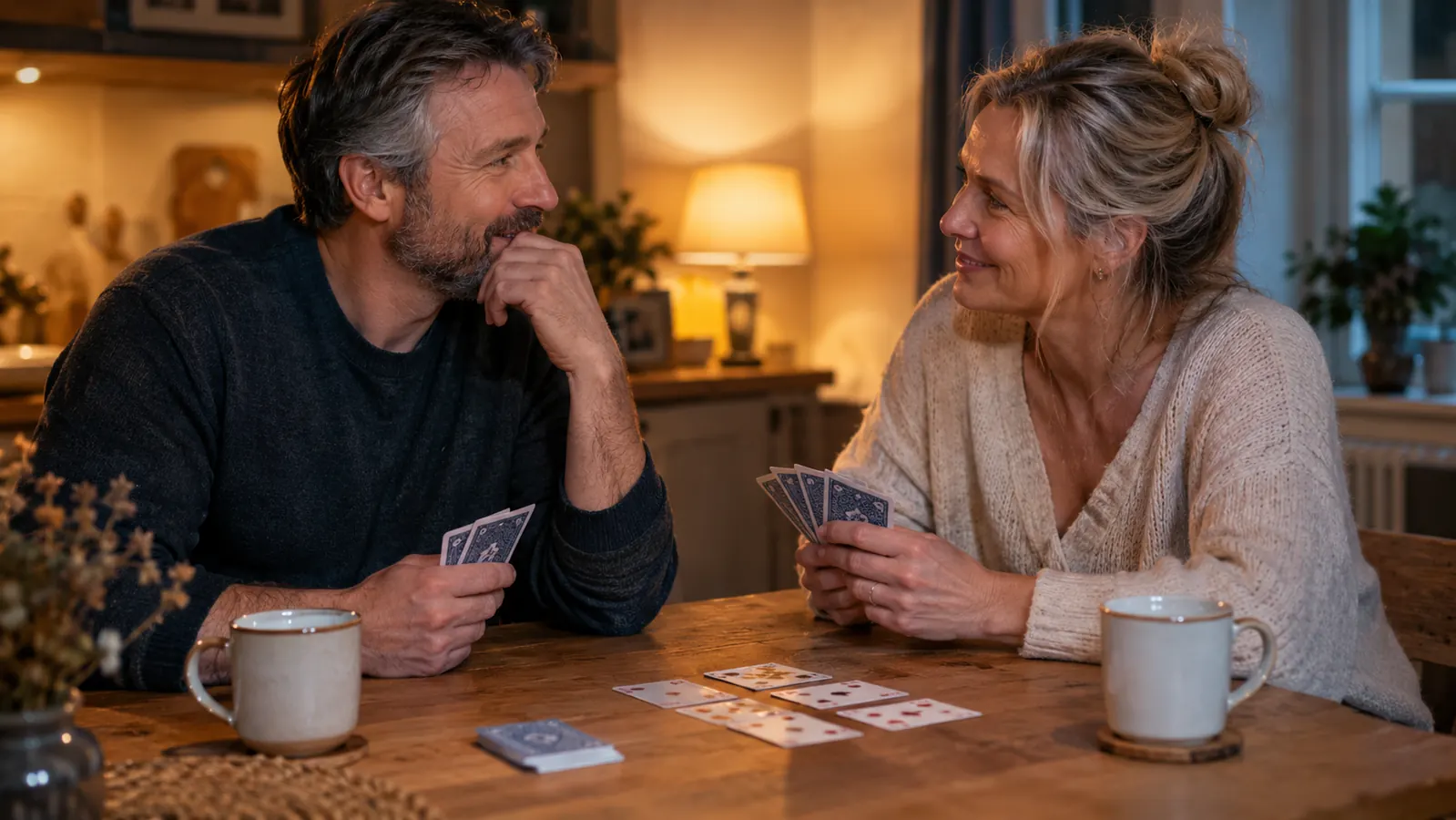
Glen and I spent years thinking date night meant reservations. We would book a table, talk about the kids and the roof and the budget, and drive home feeling like we had done something romantic without actually feeling any closer. Then a friend handed us a question deck and said, try this at the kitchen table instead. That first night, we stayed up past midnight talking about things we had not said out loud in years. This is the plan we have used ever since, and it works just as well with We're Not Really Strangers Couples Edition as it did with that first borrowed deck.
The whole point of a question game date night is to make the conversation the main event. No server interrupting, no movie competing for attention, no phones. Just two people, a deck of cards, and enough structure that the good questions actually get asked. Here is exactly how we set it up.
The deck that started our best conversations
We're Not Really Strangers Couples Edition comes with three levels of questions, from playful to vulnerable, plus wildcards and a two-player setup that keeps both of you in the game. It is the deck we reach for on Sunday nights.
Amazon Check Today's Price on Amazon →Step 1: Pick a night and protect it
The single biggest mistake we made early on was treating date night as something we would fit in if the week went well. It never went well. The week always filled up. So now we put it on the calendar like a dentist appointment, except we actually look forward to it. Sunday evening works for us because the week is winding down and neither of us is checking work email. We have kept that slot for two and a half years now, and the only times we skipped it were the two Sundays Glen came home from a job site with a fever.
You do not need a full evening. Forty-five minutes with the phones in another room beats three hours with one eye on the screen. We started with a timer on the stove so we would not lose track of time, and we still set it when we know the next morning starts early. On nights when we are both drained, we agree ahead of time to play just the first level and stop. Knowing the night has a short version makes it easier to start at all.
Tell the other person what is happening. Not in a formal way, just, hey, Sunday after dinner I want to do that card game with you. That small heads-up does two things: it gives them a chance to look forward to it, and it keeps the night from feeling like a surprise quiz. I learned that the hard way the first month, when I announced the game at the table and Glen spent the first ten minutes trying to figure out what I was really after.
Step 2: Set the table like it matters
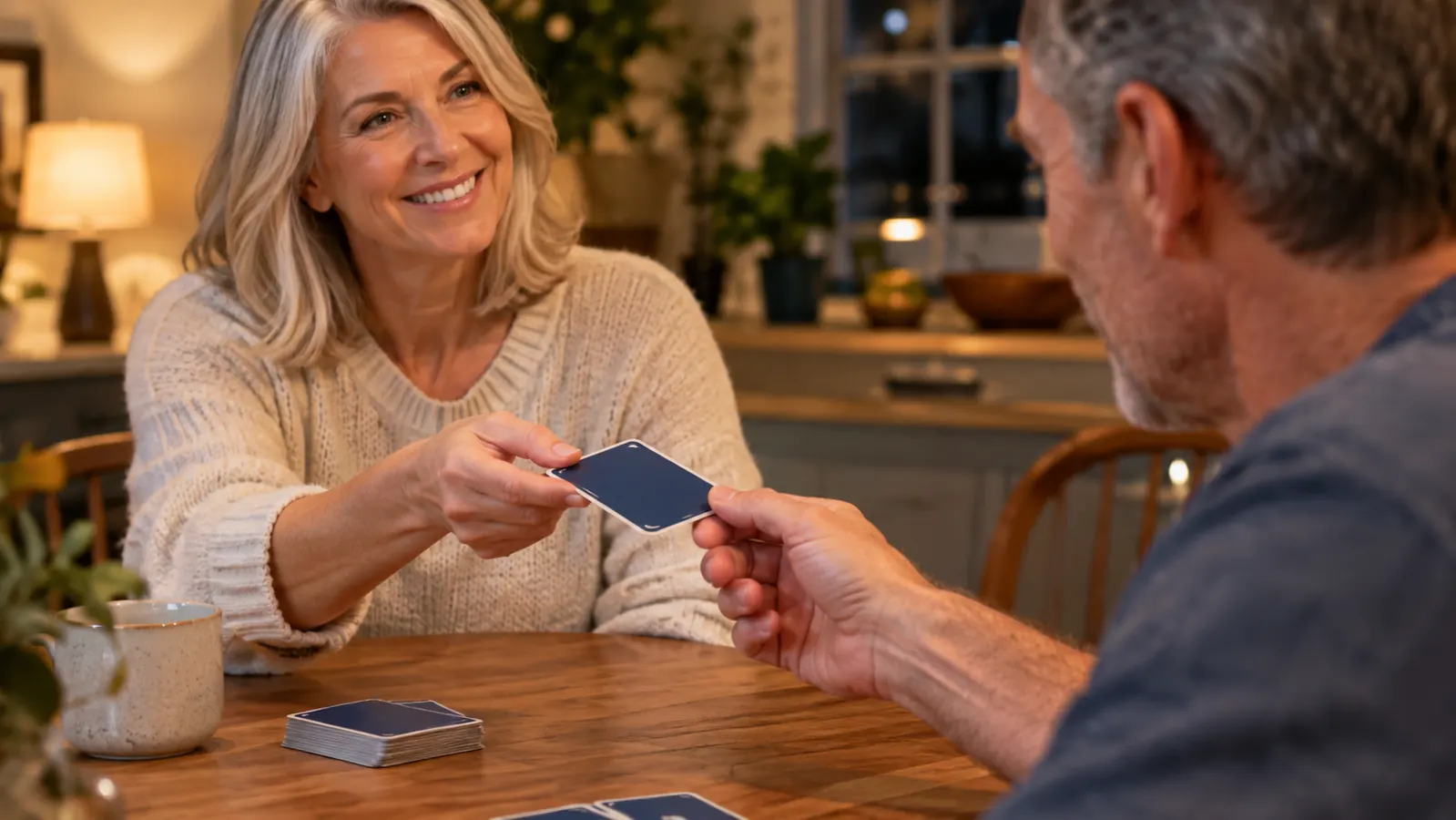
We clear the kitchen table completely. Not just the mail and the cereal boxes, everything. Then we put out two glasses of water or tea, a small bowl of something to snack on, and the deck in the middle. It sounds almost too simple, but the cleared table changes the energy of the room. It says this is the event, not a side activity while the TV plays. Our table is a four-foot oak thing we bought at a yard sale in 1998, and on game nights it somehow feels like the nicest table in the house.
Lighting matters more than you would think. We turn off the bright overhead light and use a lamp. Glen jokes that I am staging a scene, but the softer light makes it easier to look at each other without feeling exposed. That matters when the questions start getting real. We use the little brass lamp from the living room, and it throws just enough light to read a card without making the whole room feel like an exam.
Put the phones in the bedroom or in a drawer. Not face down on the table, not on silent, in another room. The first time we did this, I caught myself reaching for my pocket every few minutes. After two or three nights, the urge faded. Now the absence of phones is the thing that makes the night feel special. Glen still checks his watch more than I would like, but even that has gotten better.
Step 3: Agree on the rules before you deal
We're Not Really Strangers Couples Edition comes with its own structure, and we follow it loosely. The deck is divided into three levels. The first level is playful and light, the second goes a little deeper, and the third is where the vulnerable questions live. There are also wildcards that let you skip or swap, which sounds like a small thing but makes a real difference when one of you is tired. On a night last winter, Glen drew a wildcard and swapped a question about our first date for one about what he wants to do after he retires. That swap started a forty-minute conversation about a cabin in the Cascades.
Our house rules are simple. You can pass on any question, no explanation required. You can answer honestly or you can say, I need a minute. And we take turns reading the card out loud so both of us are doing the asking, not just one person interviewing the other. We also agreed that the answer you give is the answer that stands. No circling back to argue with it later, and no using something said at the table as ammunition in a different argument.
The pass rule is the one that keeps the game safe. Knowing you can skip a question without a lecture makes it easier to answer the next one honestly. We have both used it, and neither of us has ever felt punished for it. That is the whole trick: the game works because it is a game, not a performance review. The one time I pushed Glen to answer a question he wanted to pass, the night went flat, and I have not done it since.
Step 4: Let the conversation wander
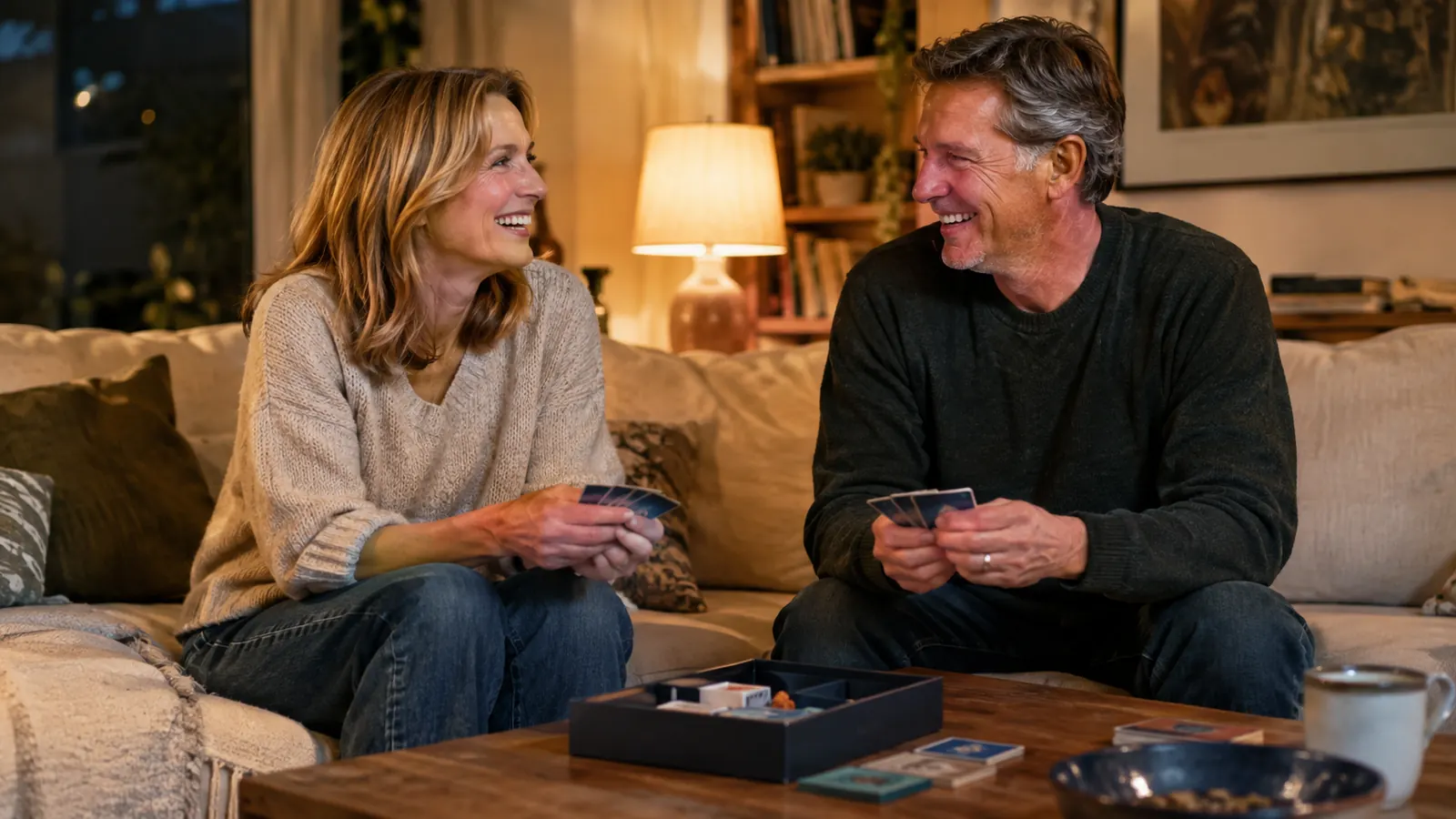
The first time we played, I thought we had to get through a certain number of cards. We did not. We got through four cards in an hour and a half because one answer led to a story, which led to a question neither of us had asked in twenty years. That is the point. The cards are a starting place, not a checklist. One question about what we were both afraid of at twenty turned into the story of the summer Glen spent firefighting in Idaho, which I had heard pieces of but never the whole thing.
When Glen answers a question, I try to resist the urge to jump in with my own story. I let him finish, and then I ask one follow-up question before I say anything about myself. That one habit changed more than any other part of the game. It turns out people say remarkable things when they are actually being listened to. The first time I tried it, Glen answered a question about his dad in a way I had never heard in thirty-one years of marriage, and I almost missed it because I was already planning what I was going to say next.
If the conversation goes somewhere heavy, let it. We have had nights where we put the cards down entirely and just talked for another hour. The deck did its job by opening the door. You do not have to finish the game to have a good date night. One night we never even got past the second level because a question about money opened the conversation we had been avoiding for a decade, and we stayed at the table until the tea went cold.
Step 5: Close the night on purpose
How you end the night matters as much as how you start it. We close by each saying one thing we appreciated about the conversation, or one thing we learned about the other person. It does not have to be profound. Last week Glen said he appreciated that I did not interrupt him during a long answer, and I told him I learned he still gets nervous before big work meetings. Both of those were worth more than a dozen generic compliments. We keep the closing to two sentences each, because the goal is to land the night, not to start a second conversation at eleven o'clock.
We also write down one question we want to ask next time. Sometimes it is a question from the deck we did not get to. Sometimes it is something that came up in conversation. We keep the list in a spiral notebook on the kitchen counter, and it gives us a thread to pick up the following Sunday. Right now the list has three questions on it, including one Glen wrote after a long silence: what did you want your life to look like at fifty-five, and how close did it come?
Then we put the deck away, clear the table, and go to bed. The whole ritual takes about ten minutes, and it is the difference between a night that feels like a nice chat and a night that actually lands. We have played on our anniversary, on a random Tuesday when Glen came home early, and on the night before our daughter's wedding, when neither of us could sleep and the deck gave us something to do with the nervous energy.
What Else Helps
A few things make the night run smoother. Start with the first level of the deck even if you have been married for decades. The light questions warm you up, and skipping straight to the deep ones can feel like a cold plunge. Keep a box of tissues nearby, not because the night will be sad, but because the good questions sometimes make people cry. And if you have never played a question game before, do a practice round with the playful cards first so the mechanics feel natural. We also learned to keep the deck in the living room where we can see it, because out of sight means out of mind, and a deck that is buried in a drawer never makes it to the table.
We're Not Really Strangers Couples Edition is the deck we keep coming back to because the questions are specific enough to start real conversations without feeling like a therapy intake. We're not therapists, and this is not therapy. It is a tool that helps two people who love each other actually talk. If a conversation ever turns toward abuse, safety, or serious mental health, put the cards down and reach out to a licensed professional. That is the honest advice I would give anyone, and it is the advice I would want someone to give my own kids.
We got through four cards in an hour and a half because one answer led to a story, which led to a question neither of us had asked in twenty years.
Your next Sunday night could be the one you remember
You do not need a reservation or a sitter. You need a cleared table, two phones in another room, and a deck of questions worth answering. We're Not Really Strangers Couples Edition is the one we reach for.
Amazon Check Today's Price on Amazon →