
Glen and I have been married 31 years, and somewhere around year 24 we realized we had become excellent roommates. We talked about the mortgage, the kids, his work schedule, and whose turn it was to buy milk. We almost never talked about us. So when I ordered the We're Not Really Strangers Couples Edition, I was hopeful and skeptical in equal measure. A card game cannot fix a marriage, and I want to be clear about that up front. But it can do something smaller and just as important: it can hand you a question you would never have thought to ask, and then get out of the way. That is exactly what this one did for us, and I want to tell you honestly where it worked, where it did not, and who should buy it.
I played it with Glen over three evenings, and I also played it with a younger couple we know, because I wanted to see whether it was just us old folks who found it useful. The honest answer is that the game is better than I expected, uneven in places, and aimed at a younger audience than the marketing suggests. Here is what nobody tells you before you buy it.
The Quick Verdict
A genuinely good conversation starter that works best for couples who are already doing okay and want to go deeper. It is not a repair kit, and some questions feel written for people in their twenties, but the best questions are worth the price on their own.
Amazon Check Today's Price →The question deck that got my husband talking past logistics
If you and your partner have fallen into the habit of talking only about schedules and chores, this deck gives you a reason to sit down and actually hear each other. It worked at our kitchen table, and it can work at yours.
Amazon Check Today's Price on Amazon →How I've Used It
The Couples Edition comes as a sturdy little box of cards divided into three levels, plus a wildcard element and a few expansion cards. The idea is that you move from lighter questions to heavier ones as you play. The first level is about getting to know each other, the second goes a little deeper, and the third is where the real conversations happen. There is also a two-player version of the game, which is the one we used, and a party version for groups. I ordered ours on a Tuesday night in October, after a week where Glen and I had exchanged maybe forty words a day, most of them about a water heater. I did not tell him it was coming. When the box arrived, I put it on the kitchen table after dinner and said we were going to try something, and he looked at it the way he looks at a new salad recipe, with suspicion and a little pity.
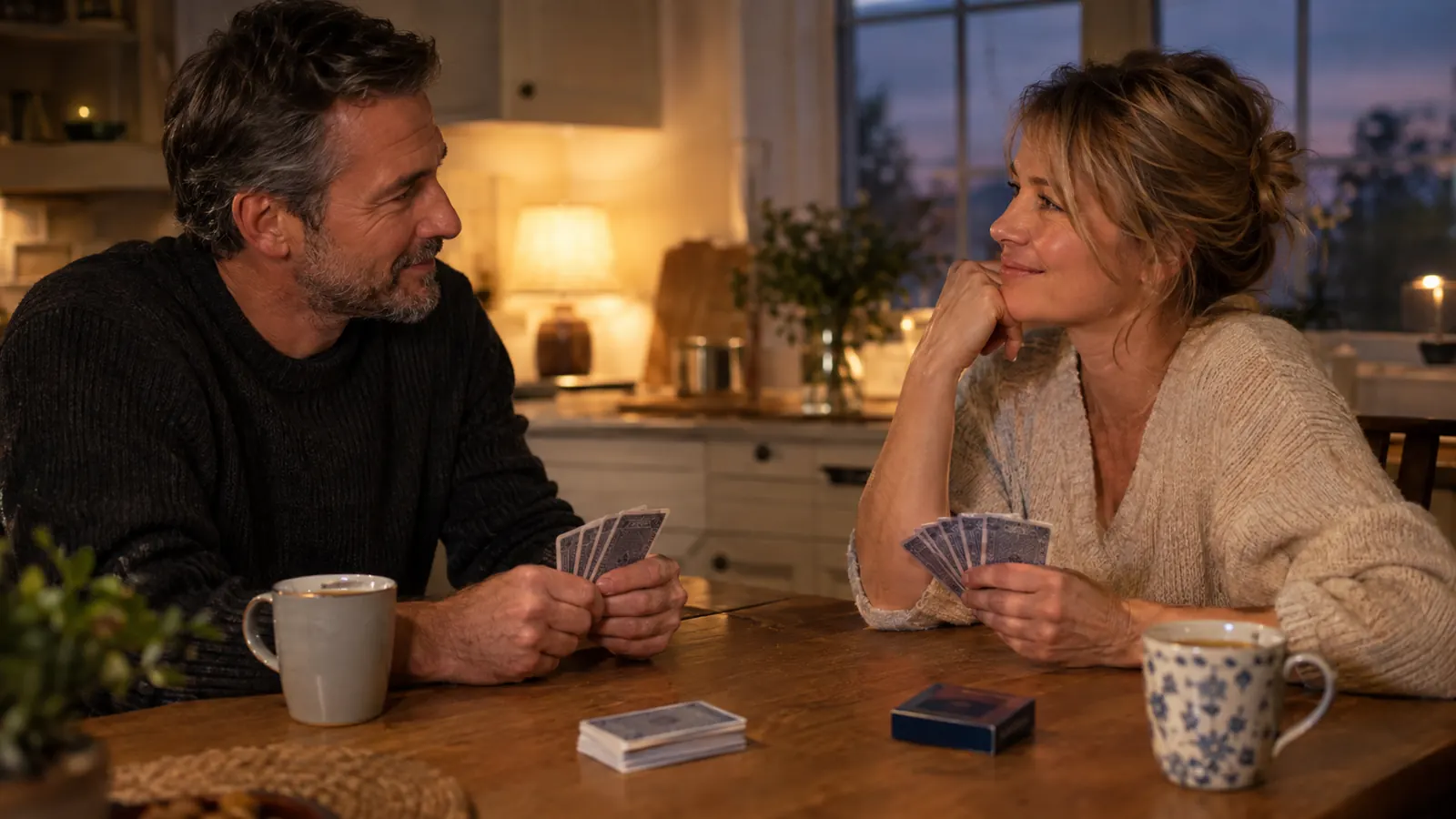
Our first evening, I expected Glen to humor me for twenty minutes and then check his phone. Instead, we sat at the kitchen table for over an hour, from about 7:15 to 8:30, with the same two mugs of tea going cold between us. The questions are specific enough that you cannot answer them with a shrug. One early question asked about a memory we each replay when we need to feel good, and Glen told me a story from our honeymoon, about getting caught in the rain and ending up in a tiny diner with paper napkins and the best pie either of us has ever had. I had not heard him tell that story in thirty years. He does not tell stories often, so when he does, I have learned to stop everything and listen. The second evening we did the middle level, and this is where the game started to feel uneven. Some questions were excellent, the kind that make you pause and think before you answer. Others felt written for people who have been dating for six months, not for people who have shared a mortgage and a minivan and a thousand arguments about the thermostat. We skipped those without guilt, because the game says you can.
The third evening was a different story. We saved it for a Sunday night, which is when we do our weekly check-in anyway, and I cleared the table before we started. The third level does not mess around. One card asked what we each need from the other that we are afraid to ask for. Glen said he needs me to stop reading his long work weeks as a rejection of me. That is a sentence we have danced around for years, and he said it because a card handed him the words. Another card asked what we would forgive each other for if we said it out loud. We did not finish the deck that night. We did not need to. We sat there until the tea was cold and the kitchen light was the only one on in the house. That is the version of the game I want to tell you about, because it is the one nobody puts in the marketing photos.

What the Questions Actually Do Well
The best thing about the We're Not Really Strangers Couples Edition is that it does not let you coast. The questions are designed to make you say something real, and they are surprisingly good at it. One question asked us to describe a time we felt proud of the other person without them knowing. Glen talked about the year I went back to school for my library science degree while working full time and raising two kids. He described coming home and finding me at the kitchen table at midnight with a stack of index cards, and he said he had never told me how much that image stayed with him. I cried a little. That is not something that happens when we watch television together, and it is not something we would have stumbled into on our own.
The game also does something clever with the wildcard cards. Instead of just reading a question, you sometimes have to do something, like hold hands for a full minute or look at each other without talking. It sounds gimmicky, and I will admit I rolled my eyes the first time a card told us to hold hands. But it breaks the physical distance that creeps into a long marriage. We are not a couple that holds hands on the couch anymore, and the game reminded us why we used to. We both laughed at how awkward it felt, and then we sat there for the full minute and neither of us pulled away first. That minute did more for us than a month of asking how each other's day went. Sometimes the body needs to catch up to what the conversation is doing.
Another strength is that the questions are not all soft. Some of them ask about the hard stuff, the arguments you keep having, the thing you are afraid to say out loud. We have been through a lot together, and I appreciated that the game did not pretend every marriage is a honeymoon. One card asked about the argument we keep having and what we are really fighting about. It gave us a way to bring up our recurring fight about money without it turning into the same old fight, because the question was on a card, not coming out of my mouth with thirty years of frustration behind it. Reading a question out loud lowers everyone's defenses. It is not my complaint, it is the card's question, and that small distance makes it possible to actually answer. We have had versions of that money conversation a hundred times. This was the first time we had it without either of us raising a voice. The card did not solve the argument. But it changed the shape of it, and that is a real thing.
The expansion cards and the 'one last thing' card are worth mentioning too. The extra cards ask things like what you would tell your younger self about love, and they are a nice change of pace when the main deck starts to feel heavy. The 'one last thing' card is a single question you are supposed to ask at the very end of the game. We have kept that tradition going after every session since. It is usually the question that gets the most honest answer of the night, because by then the ice is already broken and the defenses are down.
Glen told me a story from our honeymoon that I had not heard him tell in thirty years. That alone was worth the price of the box.
Where It Falls Short
Here is the honest part. The We're Not Really Strangers Couples Edition is clearly written by and for a younger generation. A lot of the questions assume you are still figuring out who you are, which is wonderful if you are twenty-eight and less useful if you are fifty-six and have already figured out that you hate folding fitted sheets. The first level is full of questions about the beginning of a relationship, about first impressions and early dates and the moment you knew. Glen and I met at a friend's barbecue in 1989, and we have told those stories a hundred times. We do not need a card to ask us how we met. We skipped several cards in the first two levels because they assumed a relationship that was still brand new, and ours has not been brand new since the nineties.
The third level is where the game earns its keep, but you have to get through the first two to reach it. If you are a couple that has been together for a long time, I would recommend starting with the third level and working backward, or just cherry-picking the cards that feel relevant. The game does not have to be played in order, and it is better when you treat it as a menu rather than a script. We also found the instructions a little unclear the first time we opened the box, which is ironic for a game that is supposed to be about communication. It took us a few minutes to sort out the main deck from the wildcards and figure out which cards belonged to which level. I can imagine a less patient couple just putting the lid back on and reaching for the remote.
I also want to be honest about what this game is not. It is not a substitute for counseling, and it is not going to fix a marriage that is in serious trouble. If you are in a relationship where you do not feel safe, or where there is abuse, addiction, or untreated mental illness, a card game is not the answer. I am not a therapist, and I would tell anyone in that situation to talk to a licensed professional instead of buying a box of questions. Glen and I have done our own work over the years, read the books, had the hard conversations at our Sunday check-ins, and the game works for us because the foundation is solid. If the foundation is not solid, no deck of cards is going to fix it, and pretending otherwise would be dishonest.
There is also the matter of who the questions assume you are. The deck leans heavily on the language of modern dating, terms like 'situationship' and 'love bombing' that mean nothing to my generation. That is not a flaw exactly, but it is a clue that the target audience is younger than the marketing suggests. The photos on the box show people in their twenties, and the questions match. We are not the intended customer, and we still got a lot out of it. I just want you to know that going in, so you are not surprised when half the first level sounds like it belongs on a dating app. If you are a long-married couple, plan to skip early and dig into the third level.
The Pros and Cons
What I Liked
- The third-level questions are genuinely deep and specific
- The wildcard actions break physical distance in a long marriage
- Gives you a neutral way to bring up hard topics without starting a fight
- Works for new couples and old couples, as long as you skip what does not fit
- High quality cards and box that will survive many game nights
Where It Falls Short
- Many early questions feel written for couples in their twenties
- You have to wade through lighter levels to reach the best material
- Not a substitute for real counseling if your marriage is struggling
- Some questions assume a shared future that long-married couples already have
Who This Is For
This game is for couples who are basically fine and want to be closer. It is for the couple that talks about the kids and the bills and the weekend plans, and cannot remember the last time they talked about what they actually feel. It is for the couple that has been together long enough to take each other for granted, and needs a small nudge to remember why they chose each other in the first place. If that sounds like you, the We're Not Really Strangers Couples Edition is worth a spot on your coffee table. It is also for couples who have tried the usual date night advice, the dinner out that ends with both of you looking at your phones, and want something that actually requires showing up. You do not need to be in crisis to want more from your marriage. Sometimes a simple box of cards does what a fancy dinner out cannot.
Who Should Skip It
Skip it if you are looking for a tool to save a struggling relationship. Skip it if you are not willing to answer the questions honestly, because the game only works if you actually play it. And skip it if you are the kind of couple that would rather watch a movie than talk, because this will ask more of you than a movie does. There is nothing wrong with that, but you should know what you are buying. I would also say skip it if you have already tried a question deck and hated it. This is the same basic idea done well, and if the idea itself does not appeal to you, the execution will not change your mind.
The honest bottom line: it got us talking again
No card game can save a marriage, but this one reminded us why we got married in the first place. If you want a low-pressure reason to sit down and actually hear each other, this is a good one.
Amazon Check Today's Price on Amazon →